Why is 1 BC represented by 0 in Java?
Time gets weird right at the border between BC and AD… like a calendar doing a tiny philosophical backflip 🌀
🏛️ No year 0 in the historical system
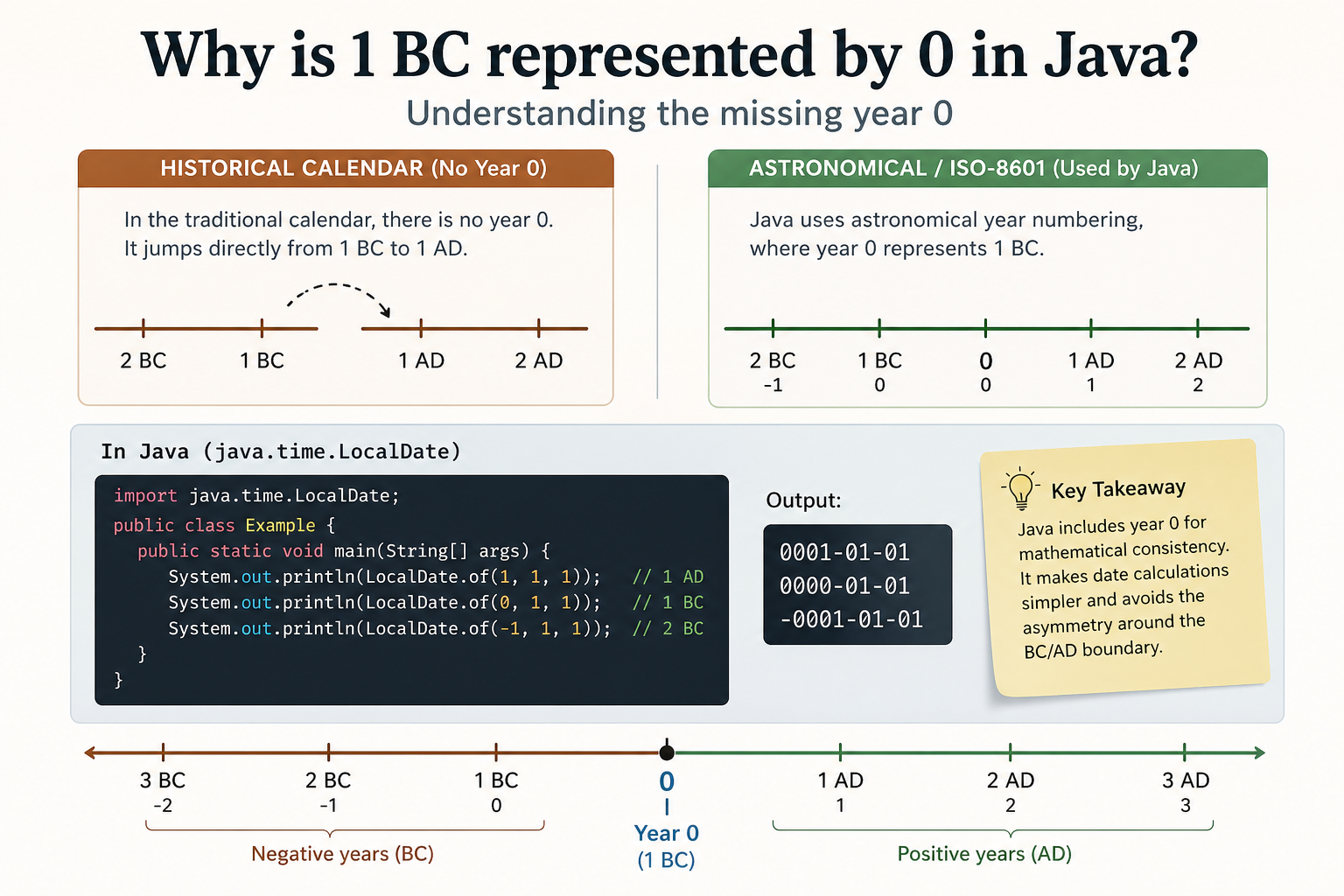
In the traditional calendar (the one historians use):
- 1 BC is immediately followed by 1 AD
- There is no year 0
Why? Because when the system was created (by Dionysius Exiguus in the 6th century), the concept of zero wasn’t really used in European numbering yet. Numbers started at 1 and marched on.
So the sequence goes:
2 BC → 1 BC → 1 AD → 2 ADNo zero sneaking in between.
💻 But Java (and astronomers) do use year 0
Programming prefers symmetry over tradition. In Java’s date system (based on ISO-8601):
- Year 0 = 1 BC
- Year -1 = 2 BC
- Year -2 = 3 BC
So the timeline becomes:
2 BC → 1 BC → 0 → 1 AD → 2 AD
        (-1)   (0)   (1)
This is called astronomical year numbering 🌌
🧠 Why this is actually smart
Think of it like a number line:
- Without 0, calculations around BC/AD are clunky
- With 0, everything becomes smooth and arithmetic behaves nicely
For example:
- Difference between 1 BC and 1 AD
- Historical: awkward 🤨
- Astronomical:
1 - 0 = 1 year✅
LocalDate example
Java uses the ISO-8601 system, so it quietly inserts that year 0.
Here’s what it looks like in code:
import java.time.LocalDate;

public class Main {
    public static void main(String[] args) {
        LocalDate date1 = LocalDate.of(1, 1, 1);     // 1 AD
        LocalDate date0 = LocalDate.of(0, 1, 1);     // 1 BC
        LocalDate dateNeg1 = LocalDate.of(-1, 1, 1); // 2 BC

        System.out.println(date1);
        System.out.println(date0);
        System.out.println(dateNeg1);
    }
}🖨️ Output:
0001-01-01
0000-01-01
-0001-01-01