🧠 List Comprehensions: Python’s One-Line Spell for Transforming Data 🐍✨
There’s a moment in every Python journey where loops suddenly feel… heavy. Too many lines. Too much ceremony. Then someone whispers a strange incantation:
[x for x in items]
And everything changes.
Welcome to list comprehensions: Python’s compact way of turning loops into clean, readable transformations. Think of it as folding a full kitchen recipe into a single elegant chopstick move 🍜
🌿 What is a list comprehension?
A list comprehension is a way to create a new list by transforming or filtering another iterable—using a single line of code.
Instead of writing:
result = []
for x in range(10):
    result.append(x * 2)
You can write:
result = [x * 2 for x in range(10)]
Same outcome. Less noise. More flow.
🧭 The structure (the secret grammar)
Every list comprehension follows this pattern:
[expression for item in iterable]
Or with a filter:
[expression for item in iterable if condition]
Think of it like a sentence:
“Give me expression for each item in iterable, but only if condition is true.”
🔍 Example 1: simple transformation
numbers = [1, 2, 3, 4, 5]
squares = [n * n for n in numbers]
Result:
[1, 4, 9, 16, 25]
A loop becomes a mirror reflecting a transformed world.
🎯 Example 2: filtering
numbers = range(10)
evens = [n for n in numbers if n % 2 == 0]
Result:
[0, 2, 4, 6, 8]
Here, the condition acts like a gatekeeper at a temple entrance 🏯
🧩 Example 3: nested loops (the mind-bender)
This is where things get interesting.
pairs = [(1, 2), (3, 4)]
flat = [x for pair in pairs for x in pair]
Result:
[1, 2, 3, 4]
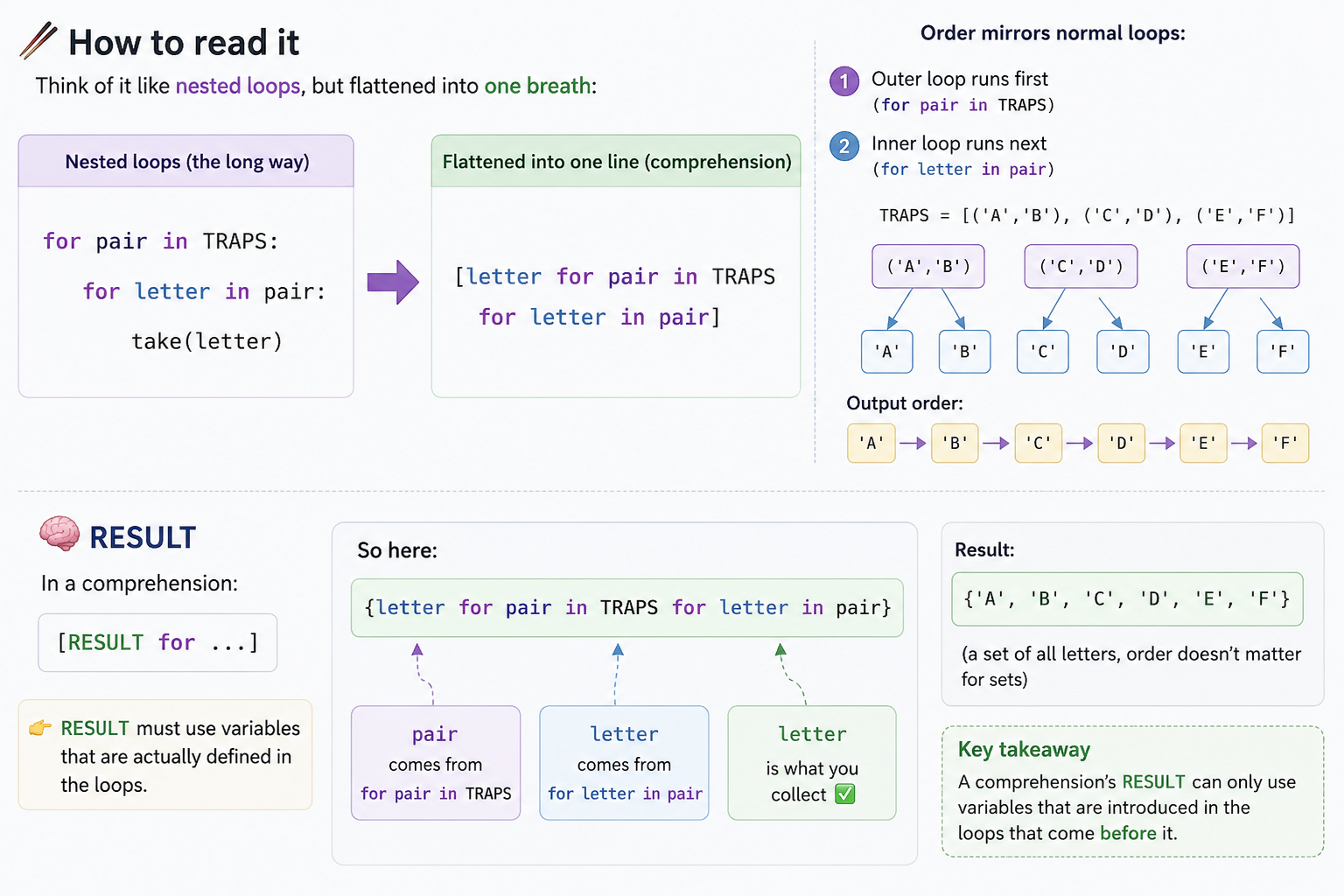
How to read it:
for pair in pairs:
    for x in pair:
        take x
The order always mirrors normal loops—just compressed into a single breath.
🐍 Common mistake: “reversed thinking”
Beginners often try to read it left-to-right like English. Python doesn’t care about your grammar—it cares about structure.
Correct reading order:
OUTER loop → INNER loop → RESULT
So this:
[x for pair in pairs for x in pair]
is NOT:
“x for x in pair for pair in pairs”
It is:
“for each pair, then each x inside it”
⚠️ When NOT to use list comprehensions
Yes, they are powerful—but not always wise.
Avoid them when:
- Logic becomes too complex
- You need multiple side effects
- Debugging readability matters more than brevity
This is bad:
[result.append(process(x)) for x in data if complex_condition(x)]
At that point, a normal loop is clearer. Python philosophy says:
“Readability counts.” 🧘
🧠 A mental model that helps
Think of list comprehensions like a conveyor belt factory:
- Items enter from the iterable
- Each item is processed by the expression
- Only some pass through filters
- The output is a new clean list
Fast. Linear. Predictable.
🥋 Bonus: set and dict comprehensions
The same idea works beyond lists.
Set comprehension:
{x for x in [1, 2, 2, 3]}
Result:
{1, 2, 3}
Dict comprehension:
{x: x*x for x in range(5)}
Result:
{0: 0, 1: 1, 2: 4, 3: 9, 4: 16}
Same magic. Different shape.
🌙 Final thought
List comprehensions are not just syntax—they’re a shift in thinking.
From:
“How do I build this step by step?”
to:
“What is the transformation I want?”
Once that switch happens, Python stops feeling like a tool and starts feeling like a language for sculpting data.
And somewhere in that simplicity, your code starts breathing a little quieter 🐍✨